
How to get more customers without guessing what they cost.
You've paid for marketing. You've seen the report. And you still can't say what one customer cost you — or whether the room was full because of the ads or in spite of them. This is the number nobody wired to your report, and the six places it leaks.
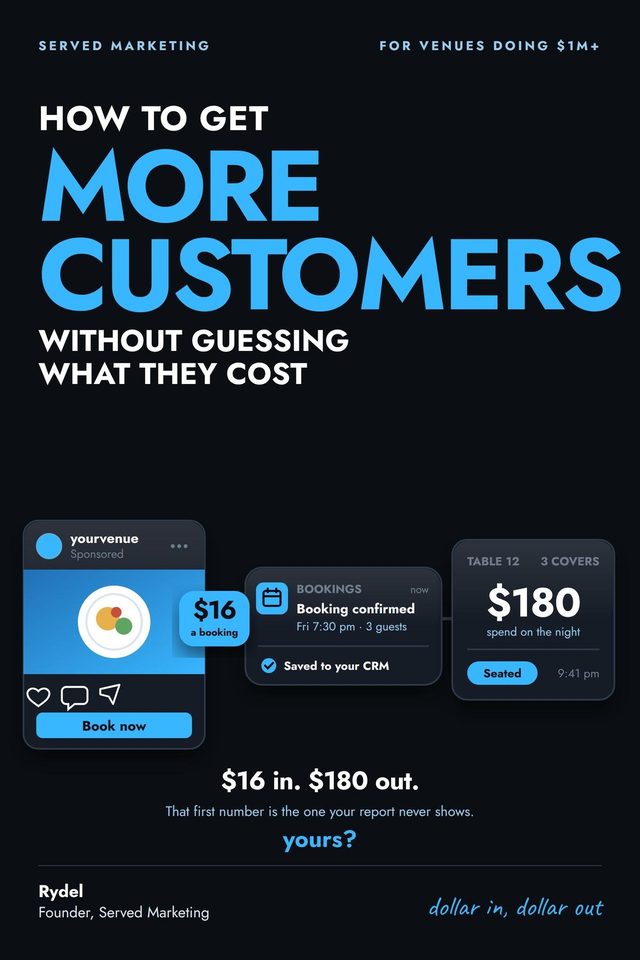
How many of these are true at your venue right now?
Tick from your own account, not from what the agency told you. Each one is a leak with a dollar figure on it.
Every tick is on a page in the guide, with what it costs an ordinary venue a year and the page that closes it.
The room isn't quiet for no reason. It's leaking in six places.
Worked for an ordinary venue — $60 a head, three at the table, 400 bookings a month. The guide shows you how to put your own numbers in. This is what each gap costs before you do.
Nobody can say what a booking costs
How you'd know: ask whoever runs your ads what one booking cost last month. Wait for the slide deck.
What it costs: everything else. Without it you can't tell a good campaign from a busy one, can't compare two agencies, and can't say whether a $2,000 month was cheap or a disaster.
Half a system
How you'd know: you run Meta or Google, the ad lands on your homepage, and nobody's name ends up anywhere you can reach again.
What it costs: on the accounts we run, the same budget makes 30 bookings at one venue and 130 at another. The difference isn't the money. It's that one venue has the whole machine and the other has one piece of it.
Discounts doing the marketing
How you'd know: 10% off, 15% off Tuesdays, half-price anything, in the last 90 days.
What it costs: Australian restaurants keep about 6 cents in the dollar after everything is paid. On a $180 table that's $11 of profit — and 10% off hands back $18 of it, to a customer who may have come anyway.
Six taps to a table
How you'd know: tap your own ad and count the taps to a confirmed table. Homepage, menu, book, date, time, details is six.
What it costs: sending an ad to a homepage instead of the booking widget roughly doubles your cost per booking, because the website loses people the ad had already convinced. You paid twice for every table.
Tables served to nobody
How you'd know: a booking nobody confirmed, and a table you couldn't re-sell at 7:30.
What it costs: between one and three in every hundred bookings never arrive (Resos, 3.77 million reservations). On 400 bookings a month that's seven tables you rostered for, prepped for and served to nobody.
A list you don't own
How you'd know: bookings go through a platform, orders through a delivery app, and last month you added zero names and mobiles to anything you control.
What it costs: a first-time customer costs around $16 to reach with ads. Reaching them again by ad costs $16 again. By text, cents. A venue doing 400 bookings a month lets about 1,200 people a quarter walk out with no way to bring them back.
For the example venue, the six gaps come to $181,450 a year.
Seats you could have filled, discounting, the leaky path, no-shows, the list you don't own, spend you can't measure. That's what the current setup costs before a single new customer walks in. Page 11 is a one-page map with a blank column next to every line. Yours takes ten minutes.
- Your number, in four lines
- Twenty real campaigns, scored — $3.03 to $59.64 a booking
- How a booking actually gets counted (and why yours probably isn't)
- The ten-question check: which of the six gaps are yours
- The four fixes — most are settings, not rebuilds
- Your Gap Map, and the four questions to send whoever runs your ads
Every report you've been handed was counting the wrong thing.
Reach and followers go up whether or not anyone booked. So a report can improve for a year while the room stays the same — and there's never a month where anyone has to explain it. This is what the same report looks like when a customer is actually counted. How it gets wired is page 4. Most venues we walk into have never had it.
This isn't theory. It's what the till looked like afterwards.
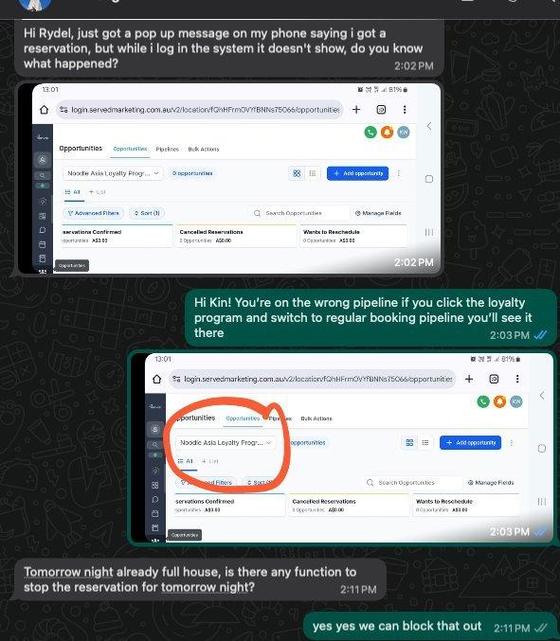
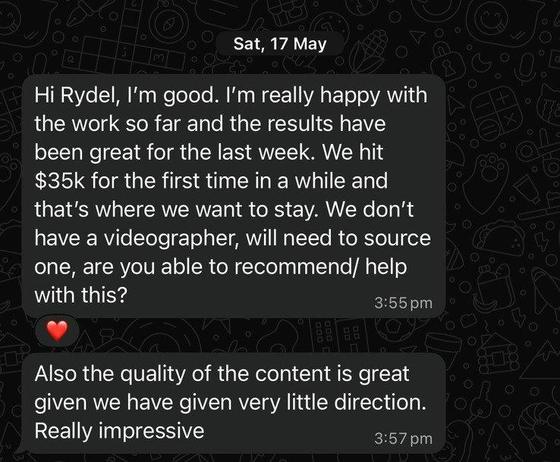
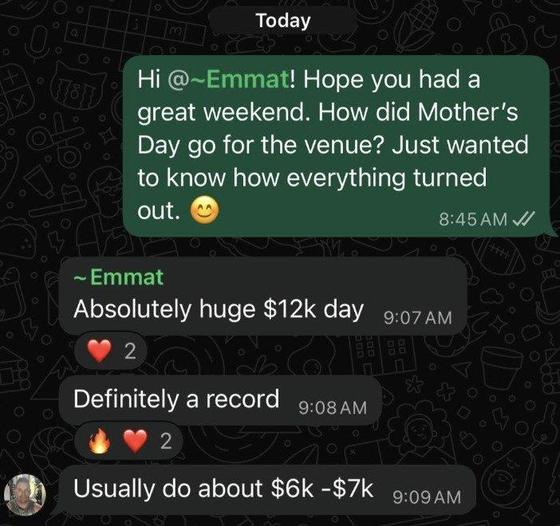
Venues that had the same six gaps, a few months after they were closed. Ordering figures from the ordering system; takings are the owners' own numbers.
We grew $15,000 in sales in a week and it hasn't slowed down since.
Emmat Crombieowner, KIS SeafoodsWe've become a lot busier. 50% of our customer base daily are new customers.
Sarah Watersowner, Panini CoPeople would come in saying they saw us on Facebook ads. That made us realise it's actually working.
Christina Theravanishowner, Chiangmai ThaiOnly one thing I need to do is just approval. They offer me, if I agree, I approve. That's helped me a lot.
Jaraslak JukwannaCEO, At ThaiThe only complaint we get is "please stop taking bookings."
Real messages from real owners. Phone numbers blacked out, nothing else touched.
The PDF lands in your inbox.
Within a minute. Built for a phone, so read it at the pass. Check promotions once if it's not there.
Ten minutes: your number and your gaps.
If you'd rather not do the maths, reply with four numbers and we send your Gap Map back filled in within one working day. No call attached.
If you want it run for you, say so.
Twenty minutes with your Gap Map, five things in writing. You keep the plan either way. Optional, and invisible if you don't ask.
Quick answers
Is it actually free?
Yes. No card, no call, no "free trial". You enter your details, the PDF arrives, and you can run every page yourself. Step 3 is there if you want it and invisible if you don't.
Who is it for — and who should skip it?
- Owners and operators of restaurants, cafés, bars, takeaways and venues around $1M+ who've paid for marketing before.
- Anyone who's been sent a report with reach on it and had a feeling it wasn't telling them anything.
- Anyone after a "post more, engage more" content plan. There isn't one in here.
- Anyone who wants followers as the goal. The unit in this guide is a person who paid.
Why do you ask why I want it?
So we send the right follow-up. Owners doing it themselves get the Gap Map offer. Owners who'd rather have it run get a session invitation. Browsers get the guide and nothing else until they ask.
Are the numbers real?
Every campaign inside is one we ran, counted in the booking system or Ads Manager. Venues are named where we have permission and described by type where we don't. Revenue figures are modelled and say so; takings are the owners' own numbers.
I'm with an agency already. Is it still useful?
More so. There are four questions inside to send them this week. Anyone running the account properly answers all four in under a minute. If it takes a week and a slide deck, you have your answer.

The three one-page tools from Rydel's YouTube videos.
Mentioned in every new video. The five biggest leaks costed, the scale-or-fix call, and the two numbers that decide it — each a few pages you fill in at the pass. Open one, download it, and if you want the whole map, the 19-page guide is above.
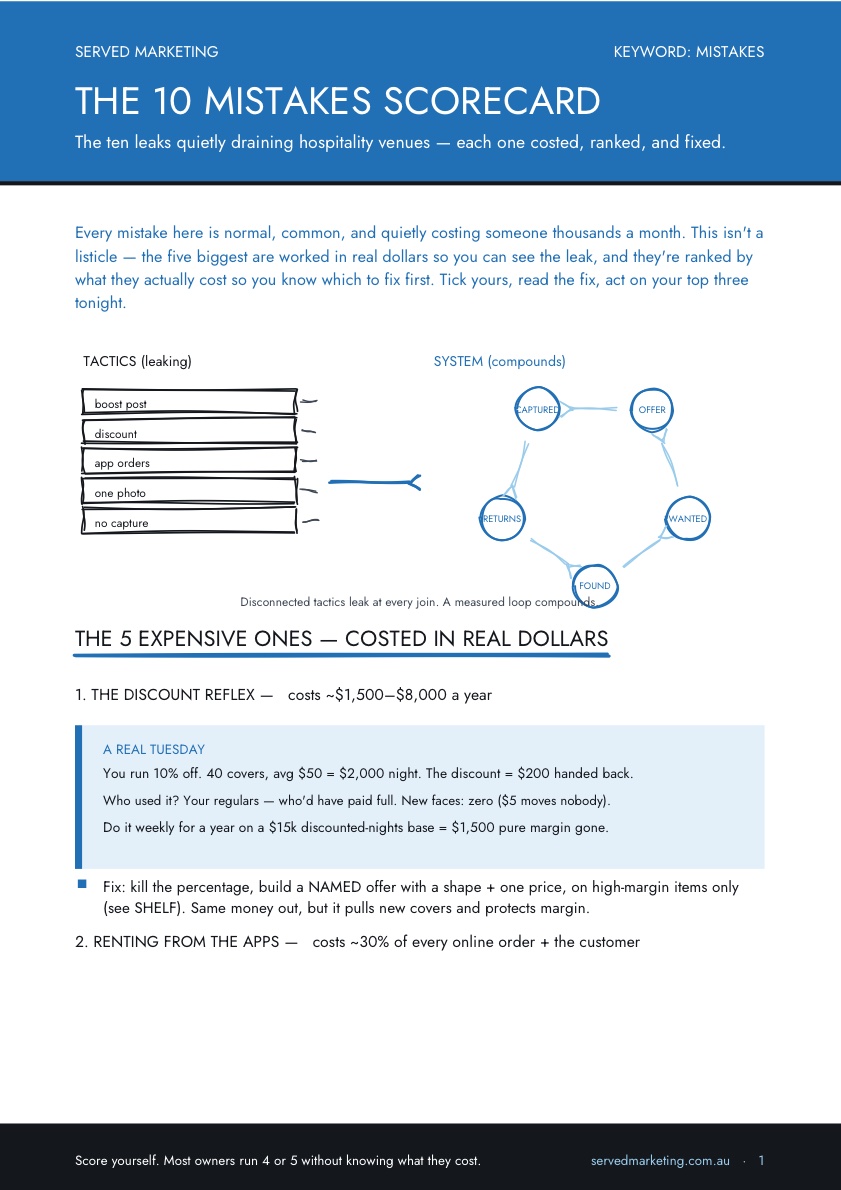
The 10 Mistakes Scorecard
The ten leaks quietly draining venues — each one costed, ranked and fixed. Tick yours; most owners tick four or five.
Open the scorecard →Free PDF · 4 pages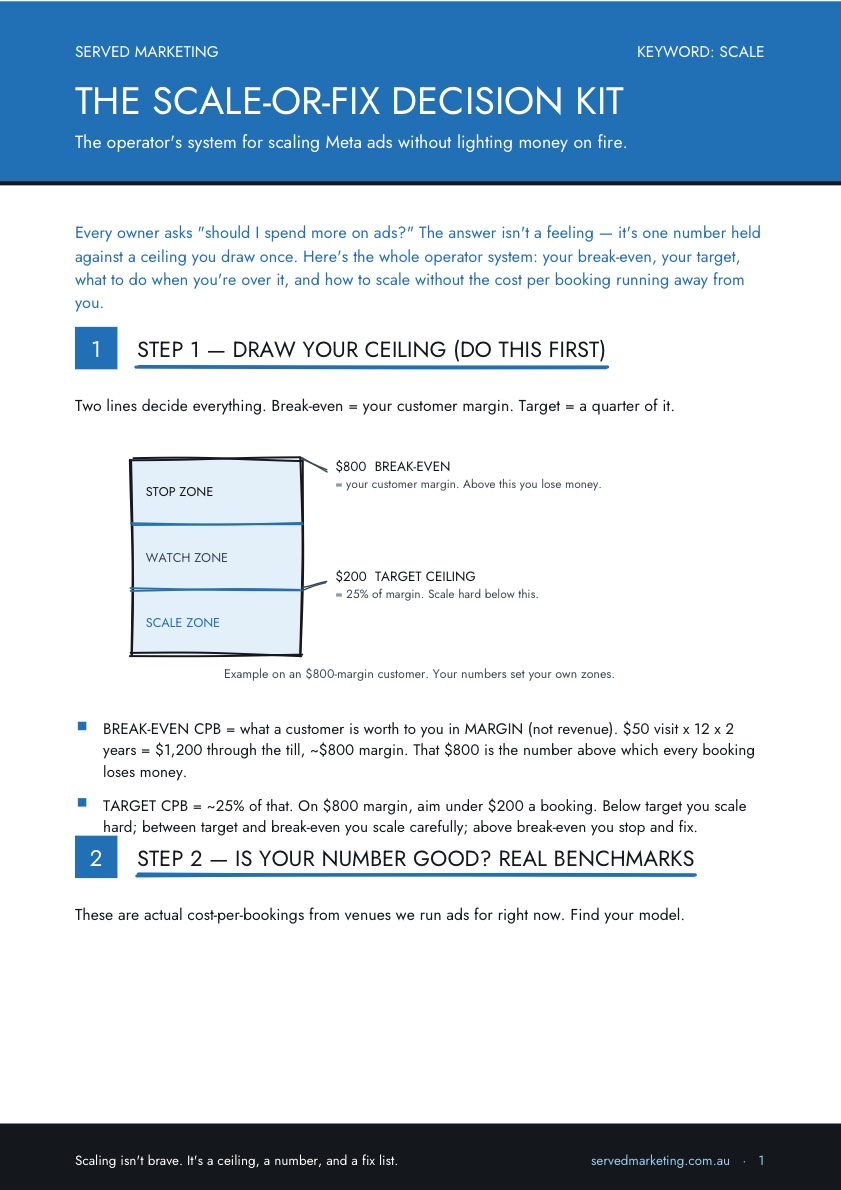
The Scale-or-Fix Decision Kit
Should you spend more on ads? Draw your ceiling once, hold your cost per booking against it, and know whether to scale or fix.
Open the decision kit →Free PDF · 3 pages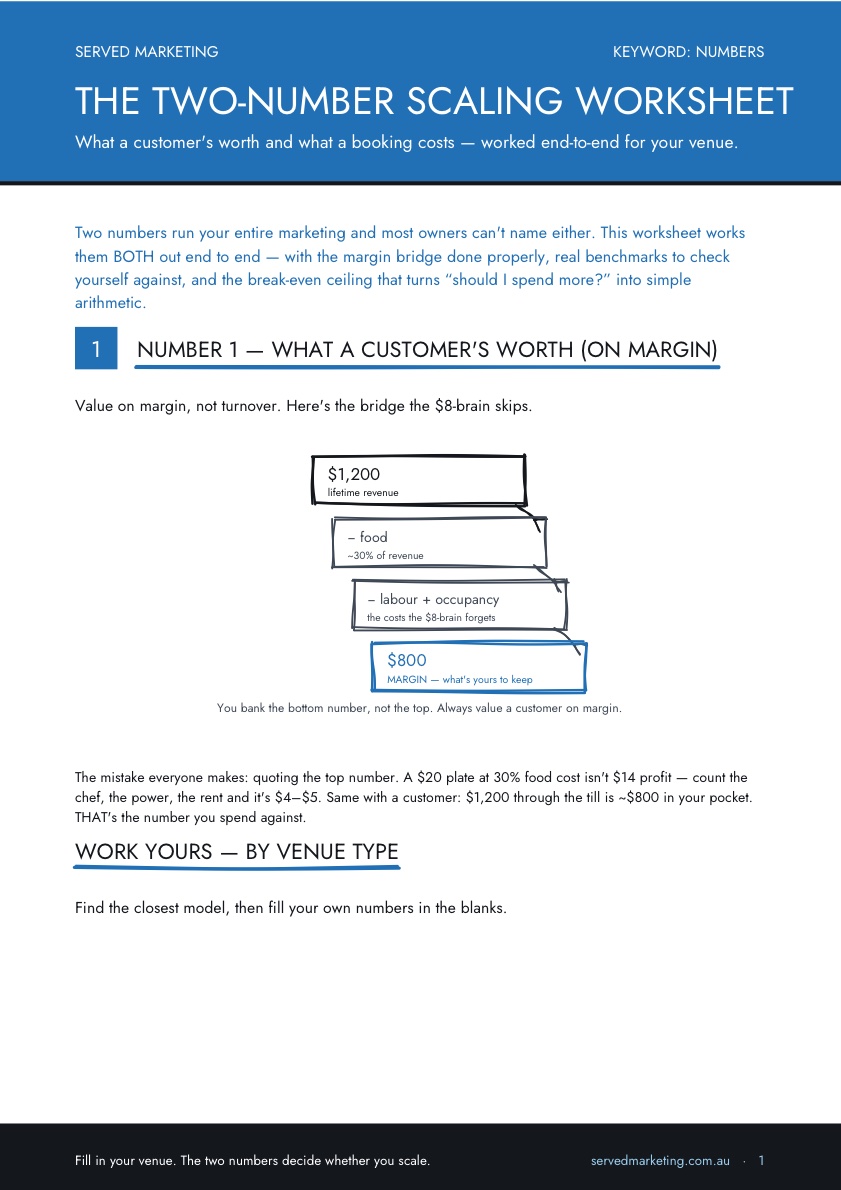
The Two-Number Scaling Worksheet
What a customer's worth on margin and what a booking costs — both worked end to end, with real benchmarks to check against.
Open the worksheet →Free PDF · 3 pagesTen minutes from now you could know your number.
What a booking should cost you, what yours probably costs now, and where the difference is going. Free, instant, nothing attached.
- The number your report never showed you — yours in four lines
- Twenty real campaigns, $3.03 to $59.64 a booking, and what separates them
- Which of the six gaps are yours, and what each costs a year
- The four questions that tell you in a minute if your agency is worth keeping